Why I Created Two Different Website Platforms for Two Very Different Business Needs
By Artur Kraft • 9 minutes read •
One thing I’ve noticed over the years is that businesses often get pushed towards the wrong kind of website.
Some are sold something far too big, far too expensive, and far too complicated for what they actually need. Others go the opposite way and try to survive on just a Facebook page or Instagram profile, thinking that is “good enough” for being online. In reality, both of those situations can hold a business back.
That is a big part of why I ended up creating two different platforms aimed at two different kinds of customers.
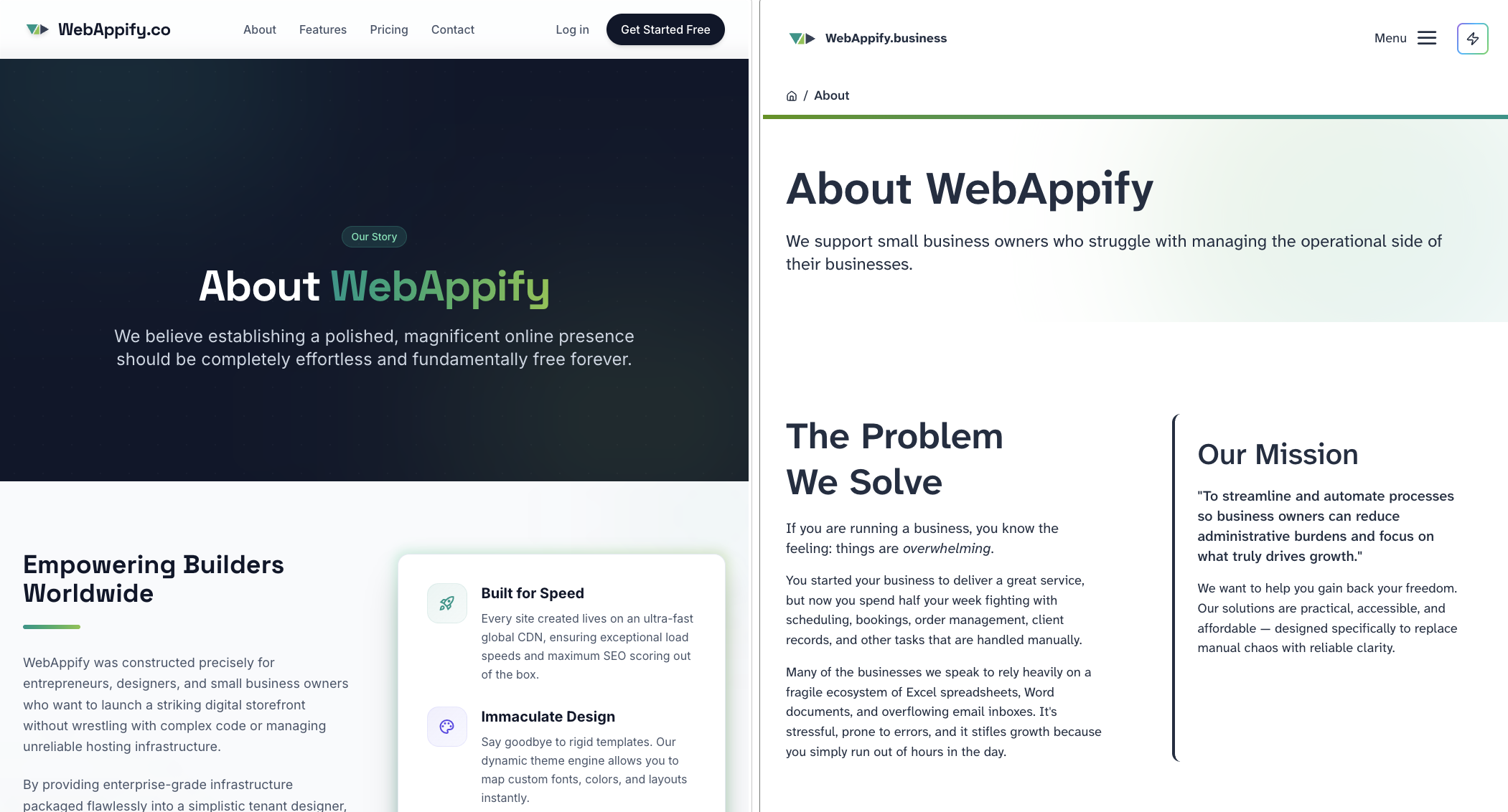
On one side, there is webappify.co, which I created for small businesses on very tight budgets who still need a proper online presence. On the other side, there is webappify.business, which is aimed at businesses that need more than just a simple one-page site and contact form. They may need a more custom website, a proper WordPress build, or even a custom web app connected to their website and their business processes.
They serve different needs, and that is exactly the point.
Not every business needs the same thing This sounds obvious, but the web industry often forgets it.
A local sole trader, a new startup, a mobile hairdresser, or a small service business might just need a clean, trustworthy place online where people can quickly see who they are, what they do, view a few photos, and get in touch. They do not necessarily need a giant website with dozens of pages, a blog, custom booking logic, member accounts, and a whole stack of features they will never use.
At the same time, there are businesses that absolutely do need more. They may need multiple service pages, stronger SEO structure, detailed galleries, lead funnels, staff areas, client dashboards, appointment systems, custom integrations, or a web app that works alongside the website.
Trying to force both of these groups into the same product never made sense to me.
That is why I split the idea in two.
Why I created WebAppify.co
WebAppify.co came from a very simple thought: a lot of small businesses desperately need a website, but they simply do not have the budget for a bespoke build.
And to be fair, sometimes they should not have to. Not everyone is at the stage where spending a lot on a custom project makes sense. But that does not mean they should be left with nothing but a social media profile and hope.
A proper website is still incredibly important.
Social media is useful, of course, but it should not be the foundation of your business presence online. Your Instagram page is not really your own space. Your Facebook page is not your own platform. Algorithms change, reach drops, platforms come and go, accounts get restricted, layouts change, and suddenly the way you communicate with customers is in somebody else’s hands.
A website is different. It gives a business its own home online.
It gives people a place to:
- Find accurate contact details.
- Understand what the business actually offers.
- See photos and branding in a cleaner, more professional way.
- Trust that the business is real and established.
- Contact them without having to dig through social media posts or old comments.
That matters more than many people realise. A lot of customers still expect a business to have a proper website. Even a simple one creates reassurance.
So with WebAppify.co, I wanted to make that step much easier.
Fast, simple, and actually usable
The idea behind WebAppify.co was not just “make cheap websites”. It was to make them fast, performant, and easy to use.
I wanted something that removed as much friction as possible. A small business should be able to get online without needing to understand hosting, themes, plugin updates, DNS headaches, SSL certificates, or any of the usual technical mess that often comes with websites.
They should be able to get a clean one-page site, edit the essentials, upload a few images, add their about text, logo, favicon, and contact information, and just get moving.
That kind of simplicity is powerful.
A small business owner often does not want to “manage a website”. They want to run their business. The website should support that, not become another admin burden sitting in the background waiting to break.
That is why making it quick and lightweight mattered to me so much. If somebody visits your website on mobile, it should load quickly. It should feel modern. It should not frustrate them. It should quietly do its job well.
That is exactly the type of problem WebAppify.co is meant to solve.
Why social media alone is not enough
I think this point deserves repeating because I see it so often.
A social media profile is not a replacement for a website.
It can support your website, absolutely. It can help with visibility, engagement, and personality. But it is not where most businesses should put all their eggs.
Social media is noisy. People are distracted. Your post is competing with friends, memes, ads, videos, and whatever else the platform wants to show that day. A website is focused. When somebody visits it, they are there for you.
There is also the trust factor. A business with only social media can sometimes feel temporary, half-started, or harder to take seriously, even if the business itself is excellent. A proper website makes things feel more established. It gives people confidence that there is something solid behind the brand.
That is especially important for small businesses trying to win trust quickly.
Why I created WebAppify.business as well
As much as I believe in simple websites, I also know that many businesses grow beyond them very quickly.
A one-page site is brilliant when it fits the need. But sometimes it does not.
Some businesses need:
- More pages.
- More detailed service information.
- More photos and media.
- Better search visibility across multiple service areas.
- More advanced lead generation.
- Better content structure.
- A more tailored design.
- Specific functionality built around how they operate.
And this is where WebAppify.business comes in.
That side is for businesses that need a more custom approach. Maybe they need a bespoke WordPress website. Maybe they need a WordPress website plus a custom web app. Maybe they already have a business process that is too manual and fragmented, and they need software around the website to support how the business actually runs.
That is a very different kind of problem from “I need a quick online presence”.
And it deserves a different kind of solution.
Why custom WordPress is still amazing
I know WordPress gets a lot of criticism, and some of it is deserved when websites are built badly. Bloated themes, random plugins, poor hosting, no maintenance, outdated PHP, and messy setups can make any WordPress site feel slow and fragile.
But a well-done custom WordPress website is still fantastic.
Honestly, in many cases, it is one of the best tools available.
Why? Because it gives businesses a really strong combination of flexibility and usability. You can create something tailored and professional, while still giving the client a familiar and manageable backend. That matters a lot in the real world.
A custom WordPress site can be:
- Fast.
- Beautiful.
- Scalable.
- SEO-friendly.
- Easy for the client to update.
- Structured properly for long-term growth.
- Integrated with other systems where needed.
And when you build it properly, rather than throwing together a pile of shortcuts, it becomes a genuinely powerful platform.
That is why I still love using WordPress for the right projects. Especially when a business needs content, flexibility, custom page structures, and room to evolve, WordPress is hard to beat.
Where custom web apps come into it
Sometimes even a great website is only part of the picture.
A business may need its website to connect to something else: a booking system, a dashboard, a customer portal, internal workflow tools, staff scheduling, lead management, document generation, payments, or some kind of automated process.
That is where custom web apps become really interesting.
For some businesses, the website is the front door and the web app is the engine room. The website brings people in, explains the services, builds trust, and generates leads. The web app handles what happens next.
That could mean:
- Managing bookings.
- Assigning jobs.
- Sending reminders.
- Handling documents.
- Storing customer data more effectively.
- Giving staff or customers a dedicated portal.
- Automating repetitive admin tasks.
For the right business, that can be transformative.
And that is exactly why I wanted WebAppify.business to exist as a broader offering. Not every company just needs “a website”. Sometimes they need a digital system that genuinely improves how they work.
Two platforms, one idea
At the heart of it, both WebAppify.co and WebAppify.business come from the same belief: businesses deserve digital tools that actually fit their needs.
Some need a free, simple, professional online presence that gets them off the ground properly and gives them something better than relying on social media. That is what WebAppify.co is for.
Others need a custom approach, a stronger website, more content, more flexibility, better structure, or a web app connected to their operations. That is what WebAppify.business is for.
I did not want to treat those as the same problem, because they are not the same problem.
And I think that is a healthier way to build digital products too: not by forcing everyone into one box, but by giving different kinds of businesses the right starting point for where they actually are.
Final thoughts
I really like this split because it reflects how businesses work in real life.
Some people just need to get online quickly, affordably, and properly. Others are ready for something much more tailored. Both are valid. Both matter. And both deserve to be done well.
So that is why I built two different platforms.
WebAppify.co is there for small businesses who need a beautiful, fast, easy online presence without cost getting in the way.
WebAppify.business is there for businesses that need more — more content, more flexibility, more custom work, more integration, and more strategy behind what gets built.
In the end, it is all about using the right tool for the right stage of the business.
Comments
You can comment on this blog post by publicly replying to this post using a Mastodon or other ActivityPub/Fediverse account. Known non-private replies are displayed below.